In this unit, we discussed Global Warming and how it affects the environment around us. We researched how weather and climate are changing over a period of time, due to Global Warming. We conducted this investigation to help us become meteorologists in our own little worlds. I was surprised to find out how pollution can affect wildlife and the melting of ice caps. The most challenging part of this project was the slideshow below, it was a long process but worth it. I'm proud of myself for accurately converting Fahrenheit to Celsius!
Monday, October 21, 2013

Friday, October 18, 2013
The Environment's End
Reflection: The purpose of this investigation is to help us understand the importance of keeping our environment stable. This project was all based on MDG’S 7 & 8 (Environmental Sustainability and Global Partnership for Development). Our teacher let us choose what issue we wanted to address in our poem. As seen in my poem, I chose Deforestation. I chose Deforestation because it seemed interesting and nobody else really picked it. I wanted to expand my mind to new things. The most important thing to get out of this project, is a feelings for how people are trying to handle our world’s problems. The most difficult part of this was definitely my picture, I’m not a drawer at all. So for me to create this, it was pretty awesome.

“The Environment’s End”, DR, Drawn, 17 Oct, 2013.
My photo represents an overall unhappy environment. Trees on fire, deadly looking roots, smoke all in the air. Clouds turning black and the sun unhappy.
“The Environment’s End”
They are not good people,
They obliterate natural environments.
All the things we love, need, praise, are lost
Not destroyed, but completely destroyed
Deforestation is a crime, a felony,
It should be forbidden,
Our animals come to your home, tear it down
then call it a day.
You’re not alone, they feel the same way.
Fires spread from forest to forest
but men don’t care, they promote it.
How do we expect to reach our goal,
if Men don’t go through with it?
We have to keep our forests safe.
Every year,
30,000 sq. mi of forest land are lost
due to Deforestation.
Is this what you all want?
Fire, death, natural extinction?
At the rate we are going,
ALL rain forests can vanish in 100 years.
That’s not cool,
At least someone notices it.
FOTFP ( Friends Of The Forest Preserves)
have been helping with our Deforestation problem
for over 10 years.
They understand how Deforestation can
not only harm the environment, but us too.
If you didn’t know,
Deforestation lets off bad toxins in the air,
polluting our oxygen that we breathe in.
A wise lady I once spoke to,
told me that Deforestation can lead to disease spread.
Imagine if an infected rodent got kicked out of his natural habitat
and he had to find a new home,
coming in contact with more humans,
giving away diseases.
About 70% of our animals live in forests,
they can’t adapt anywhere else.
So now, you’re killing animals too?
Some type of American,
I thought we needed animals to survive?
How can you just sit there and stare at me,
while this is happening as we speak?
Unless you want an unstable environment I would take action,
NOW!
References:
“Deforestation: Facts, Causes & Effects”, livescience.com, Jessie Szala, Web. 13 Oct, 2013.
“Deforestation”, environment.nationalgeographic.com, n.p. Web. 17 Oct, 2013.
Kanusch, Barbara, personal interview with CDC worker, 16 Oct, 2013.
Kanusch, Barbara, personal interview with CDC worker, 16 Oct, 2013.
Friday, October 4, 2013
Filter That Water !!
This water unit was all about water filtration and how water is given to us. We have been studying how water is made into potable drinking water through the “Water Cycle”. I have to say, i’m kind of proud of my water filter and how it worked. The most difficult part, by far, would have to be gathering materials for the project. I have learned that no matter how much some water is filtered, it will still be dirty.
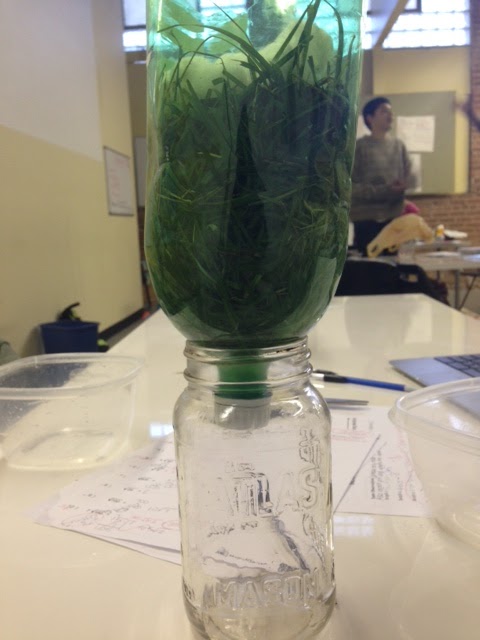
“Filter that water”, D.R., 1 Oct. 2013.
The only materials needed for this project are: cylindrical container (preferably tall), knife/ scissors, 2 Mason jars, grass/dirt, unfiltered water source, charcoal/ activated carbon, and coffee filters. To build a filter, take these steps: First, gather the materials above. Cut the cylindrical container in half and poke a hole in the cap. Next, stuff the cotton balls in the cap of the bottle. Layer grass and dirt on top of the cotton balls. After, put the cylindrical container in the mason jar, so that the filtered water can be collected. Test the pH of the unfiltered water and record. Pour unfiltered water into the cylindrical container. After the water has filtered through the apparatus, add a pinch (about a gram) of activated carbon. Gently swirl the water to mix the carbon. Filter the water a second time through coffee filters into another Mason jar. Lastly, re-test the pH of your filtered water and record.
How the filter worked was simple; the different layers in the cylindrical container filtered out the bigger debris, whereas the charcoal bound to impurities in the water and sterilized it. My filter worked by using the different properties inside the filter to catch extra dangerous particles in the unfiltered water. The layers catch the debris that shouldn't be in the water, such as dirt, sand, and waste particles. I know that my filter did something to my water, because not only did the color change, but so did the pH.
Before filtration, the water measured a pH of 7, which is neutral, meaning neither acidic or basic. Water at a pH of 7 is health to drink, and falls within the “safe zone” for humans. I was extremely surprised that the filtration process LOWERED the pH to 5, a more acidic value, and outside the “safe” drinking range. Using the log equation for pH (pH = -log [H+]), I know that a pH of 5 is 100 times more acidic than a pH of 7, and also has more hydrogen ions.
I would like to follow up this project with more experiments. In doing so, I might figure out why the pH became more acidic, rather than just cleaner and better tasting. I also wonder, if I had started off with an extremely acidic or basic pH, would the filter have improved the quality of the water? These are some ideas I’m interested in exploring.
References:
“Water Purification.”, n.p. Web. 4 Oct. 2013.
Thursday, October 3, 2013
Salário de 3 pontos
In this investigation, I learned the importance of Gender Equality. Throughout the investigation I realized that the way women are portrayed, is the whole reason why they are treated differently. If women continue to do the same things, how do they expect people to look at them differently? If women follow their own stereotypes then how are they going to ever change the men's perspective? As explained in my title; "Salário de 3 pontos" (3 point salary), i'm researching Women's Basketball Salaries v.s. Men's Basketball Salaries in The U.S. and Brazil.

"My visual." D.R. Creation on Spreadsheet, 2 Oct 2013.
This graph represents basketball players average salary over the last couple of years.
I used colors based on the colors in the two countries flags.
This visual explains it all, gender inequality is major in this department.
Springfield
607 East Adams
Suite 1520
Springfield, IL 62701
Dear Mark Kirk,
I am DR. I go to GCE( Global Citizenship Experience), a very different school. I live in the Englewood neighborhood in Chicago, IL. I am regarding the pay of athletes. My investigation is addressing MDG 3 (Millennium Development Goals), about gender inequality and empowerment of women. The target of MDG 3 is to eliminate gender inequality in all economical ways by 2015. I am addressing a certain part of MDG 3, though i’m addressing, MDG3: 3.2, talking about women’s wage comparisons. Right now in our country, players in The NBA ( National Basketball Association) get payed up to 100 million dollars a year. Meanwhile, players in the WNBA (Women’s National Basketball Association) get payed up to 107k a year. Earlier in my investigation I saw a film called, “ Miss Representation” and I realized how women are portrayed, is the whole reason why they are treated differently. How women are expected to act, is why people don’t realize their inner ability. Even the name of “Alpha Male” explains it all, this name is so stereotypical that people don’t realize it. We are missing key ideas in everything, leaving women out of the picture.
In the last couple of years, Brazil has made major changes in their professional institute. Some of their professional sports are Co-Ed, like volleyball. Even though their basketball isn't Co- Ed, their players are relatively payed the same amounts (men and women). If you think about it, some very talented payers like; Tiago Splitter and Leandro Barbosa come from Brazil. Brazil is actually a widely sports based country. They have won tons of metals in Olympics and professional competitions.
I believe that Brazil's example of gender equality can rub off well on the U.S. In my visual it shows how equal the salaries of players in Brazil are (men and women). Even though they get payed nowhere near as much as NBA players, you can see the difference in salaries. We, as a country, need to acknowledge the fact that we have an equality issue. Just the fact that we have a 4.5 million dollar gap in our professional institution, should notify you why we aren't in the top 50 countries, regarding gender equality. I can suggest that we start closing in that salary gap by taking away unnecessary money from NBA players that don't deserve it. In my opinion, Women's Basketball players work as hard as Men's Basketball players and should get payed somewhere near the same amount that NBA players get payed.
In conclusion, I want to see more women treated equally in sports. Why is it that WNBA players can get payed up to only $107,000 and NBA players can get payed up to $70 million? Why is it that I cant name any WNBA teams, but I can almost name all the players in the NBA? We are richer than Brazil, doesn't this mean we have the resources to make this happen? We are even one of the richest in the world, and we can't use the resources provided to even out women's salaries? Why is this so? Why can't we offer a better living for our women? All I am asking for is reasonable equality.
References:
"My visual." D.R. Creation on Spreadsheet, 2 Oct 2013.
This graph represents basketball players average salary over the last couple of years.
I used colors based on the colors in the two countries flags.
This visual explains it all, gender inequality is major in this department.
Springfield
607 East Adams
Suite 1520
Springfield, IL 62701
Dear Mark Kirk,
I am DR. I go to GCE( Global Citizenship Experience), a very different school. I live in the Englewood neighborhood in Chicago, IL. I am regarding the pay of athletes. My investigation is addressing MDG 3 (Millennium Development Goals), about gender inequality and empowerment of women. The target of MDG 3 is to eliminate gender inequality in all economical ways by 2015. I am addressing a certain part of MDG 3, though i’m addressing, MDG3: 3.2, talking about women’s wage comparisons. Right now in our country, players in The NBA ( National Basketball Association) get payed up to 100 million dollars a year. Meanwhile, players in the WNBA (Women’s National Basketball Association) get payed up to 107k a year. Earlier in my investigation I saw a film called, “ Miss Representation” and I realized how women are portrayed, is the whole reason why they are treated differently. How women are expected to act, is why people don’t realize their inner ability. Even the name of “Alpha Male” explains it all, this name is so stereotypical that people don’t realize it. We are missing key ideas in everything, leaving women out of the picture.
In the last couple of years, Brazil has made major changes in their professional institute. Some of their professional sports are Co-Ed, like volleyball. Even though their basketball isn't Co- Ed, their players are relatively payed the same amounts (men and women). If you think about it, some very talented payers like; Tiago Splitter and Leandro Barbosa come from Brazil. Brazil is actually a widely sports based country. They have won tons of metals in Olympics and professional competitions.
I believe that Brazil's example of gender equality can rub off well on the U.S. In my visual it shows how equal the salaries of players in Brazil are (men and women). Even though they get payed nowhere near as much as NBA players, you can see the difference in salaries. We, as a country, need to acknowledge the fact that we have an equality issue. Just the fact that we have a 4.5 million dollar gap in our professional institution, should notify you why we aren't in the top 50 countries, regarding gender equality. I can suggest that we start closing in that salary gap by taking away unnecessary money from NBA players that don't deserve it. In my opinion, Women's Basketball players work as hard as Men's Basketball players and should get payed somewhere near the same amount that NBA players get payed.
In conclusion, I want to see more women treated equally in sports. Why is it that WNBA players can get payed up to only $107,000 and NBA players can get payed up to $70 million? Why is it that I cant name any WNBA teams, but I can almost name all the players in the NBA? We are richer than Brazil, doesn't this mean we have the resources to make this happen? We are even one of the richest in the world, and we can't use the resources provided to even out women's salaries? Why is this so? Why can't we offer a better living for our women? All I am asking for is reasonable equality.
References:
“Top Sports Salaries by Country, 2011.” topendsports.com, n.p. Web. 2 Oct. 2013.
“The Global Gender Gap.” forbes.com, Meghan Casserly Web. 2 Oct. 2013.
“About Mark.” kirk.senate.gov, n.p. Web. 2 Oct. 2013.
“How Much Money Do Basketball Players Make In Brazil.” wiki.answers.com, n.p. Web. 2 Oct. 2013.
“NBA’s ‘average’ salary -- $5.15m -- a trendy, touchy subject.” nba.com, Steve Aschburner Web. 3 Oct. 2013.
“The Global Gender Gap.” forbes.com, Meghan Casserly Web. 2 Oct. 2013.
“About Mark.” kirk.senate.gov, n.p. Web. 2 Oct. 2013.
“How Much Money Do Basketball Players Make In Brazil.” wiki.answers.com, n.p. Web. 2 Oct. 2013.
“NBA’s ‘average’ salary -- $5.15m -- a trendy, touchy subject.” nba.com, Steve Aschburner Web. 3 Oct. 2013.
Friday, September 20, 2013
R.A.G.E Local Profile By DR
The purpose of this investigation was to find out how organizations are helping out in their area, no matter what they might work with: food, students, or even the community as a whole. I chose R.A.G.E (Resident Association of Greater Englewood) as the organization I would study. What they do is simple: they try to establish a more positive change in the Englewood community. Englewood may not be the most popular neighborhood right now, but that’s why R.A.G.E is there. I learned that some people do care, despite the fact that Englewood still isn't at its best. We don’t pay enough attention to those who do care. We went on a field experience to Englewood, walking around, counting liquor stores and vacant lots, and meeting with Growing Home, an organization that provides fresh produce for the Englewood community. Overall, I loved this investigation, and how much I learned throughout the whole unit.

"Englewood Community." n.p. Web. 20 Sep. 2013.

I chose R.A.G.E as my organization. R.A.G.E is also known as Resident Association of Greater Englewood. I chose the Englewood community because in the last month alone, 5 homicides were committed, and because it's my neighborhood and i wanted to see what people were doing to stop the violence (Chicago Tribune). I chose R.A.G.E also because I wanted to know more about my hometown and I wanted to address the Englewood problem. The reason I’m interested in the Englewood community is because I want to see what people are doing to prevent the crime in Englewood. I also want to know who actually cares about the poverty levels on the south side of Chicago. I am also kind of concerned because I live in the Englewood community.
What R.A.G.E. does is provide resources for people to mobilize themselves and help force a change in the Englewood community. This means that they break down problems in the Englewood neighborhood, creating positive solutions to them, preventing violence and reducing poverty rates. Established in 2010, R.A.G.E. has been working towards making Englewood a better place and looks forward to big things in the future. They increase access by providing programs for those in need of jobs and education, they're widely open to the environment and increase access to needs and wants of the people, needs and wants that they may not be able to provide for themselves. The finders of R.A.G.E are in many departments of business such as home owning, stakeholders, business owners, professionals, students, parents, and grandparents, all fighting towards a better environment.
I learned there are actually people out there that care about the Englewood neighborhood. I also learned that R.A.G.E’s presence in the community is rapidly growing. On Maslow's Hierachy of Needs, I would say that this most relates to Employment and self-esteem. I think the change they are trying to make in the community is great. A woman named Asiaha Butler explained the variation of assets and resources in the Englewood community. She says that R.A.G.E. launched an Englewood tour of some such, touring many parks in the area. They came across Sherwood, Hamilton, Lindblom, and finally Ogden Park. Keeping R.A.G.E. members busy, the tour became a hit of the summer.
I can go volunteer at the organization to help out. The target my organization addresses is: to achieve full productive employment and decent work for all, including younger people. Even though the organization is based on Poverty (MDG1) and developing a new community, it is somewhat helping out with Primary Education (MDG2) too. To help out my organization, I can do many things, such as attend one of the events, spread the word, or contribute to the cause. They have certain events where people can come and participate, such as cookouts and tours. These events only grow the organization, putting the word out there can attract the attention of anyone, including any big corporations looking to sponsor.
To conclude, this investigation has taught me much about the depths of the Englewood community. It has taught me about who actually fights for peace inside the community. Walking the Englewood neighborhood was actually better than I thought. Directions are a bit confusing there, but it’s a jungle, if you have ever been in the Englewood community there is so much opportunity. The extreme vacancy there is fascinating. Who will buy the free space? Why was it abandoned? What will be made out of it? All fascinating questions, for a fascinating, developing place.
References:
"About." rangenglewood.org, n.p. Web. 15 Sep. 2013.
Asiaha Butler, In person 11 Sep. 2013.
Tuesday, September 10, 2013
H20-Deep Blues By DR
This project was all about comparing and contrasting daily water usages to different countries. The purpose of this project was to get a better understanding of water usage, and maybe even appreciate it more. I enjoyed learning about other daily water usages, I've realized just how much water I used. I use 139 gallons daily, that's completely ridiculous. On the regular, there's people out there that use around 40 gallons of water a day. I've learned that people in Japan aren't so different from me, surprisingly. Thank you, and please view the data i collected below. My daily water usage on the left, and Japan's on the right.


DR (2013) My Water Usage vs Japan's. Internet: Infogram.
In this investigation I ended up having 139 gallons as my daily water usage. I split my day up into 4 daily water categories. Hygiene, Consumption, Chores, and Garden. I ended up with 122 gallons in the hygiene department, 90% of my whole daily water usage. Garden and Consumption didn’t make up much, however daily chores ended up being 6% of my daily water usage. I chose Japan to Compare/Contrast with because I am somewhat fascinated with Japan’s history. My sources say that a normal person in Japan uses about 375 liters of water a day, or 99.2 gallons. The difference between Japan’s daily water usage and mine is about 39.8 gallons. I estimated that it would take me 2-4 hours to carry my own daily water usage from the nearest water source. It’s about 1 or 2 miles away. To conclude, this whole investigation has taught me to value water A LOT more.

LEITE, Carlos (2013) Carry Water!! Chicago: GCE
Subscribe to:
Posts (Atom)